
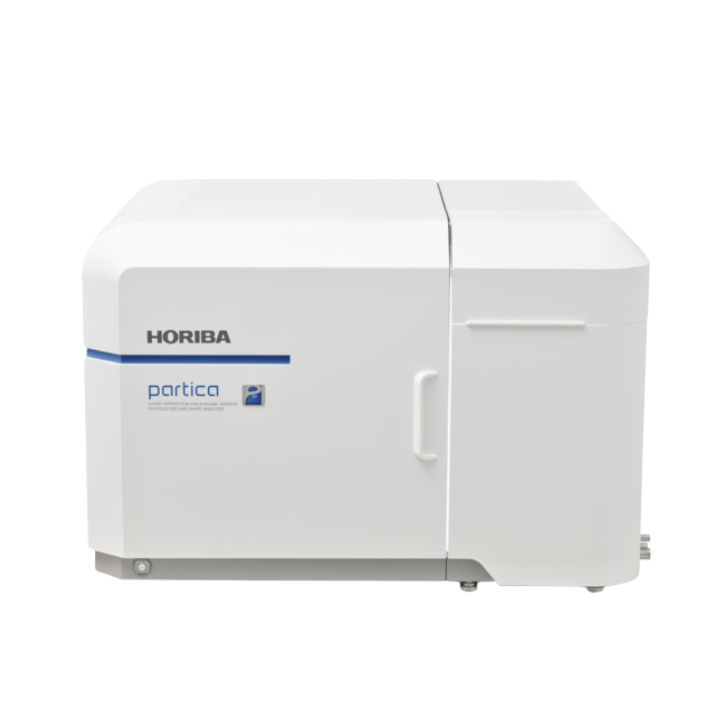
Partica combines these complementary techniques in a single instrument, capturing particle size distribution and shape simultaneously to reduce measurement time, streamline R&D and QC workflows, and save lab space.
Key features
- All-in-one system combines laser diffraction/scattering particle size distribution measurement and dynamic imaging–based particle shape analysis
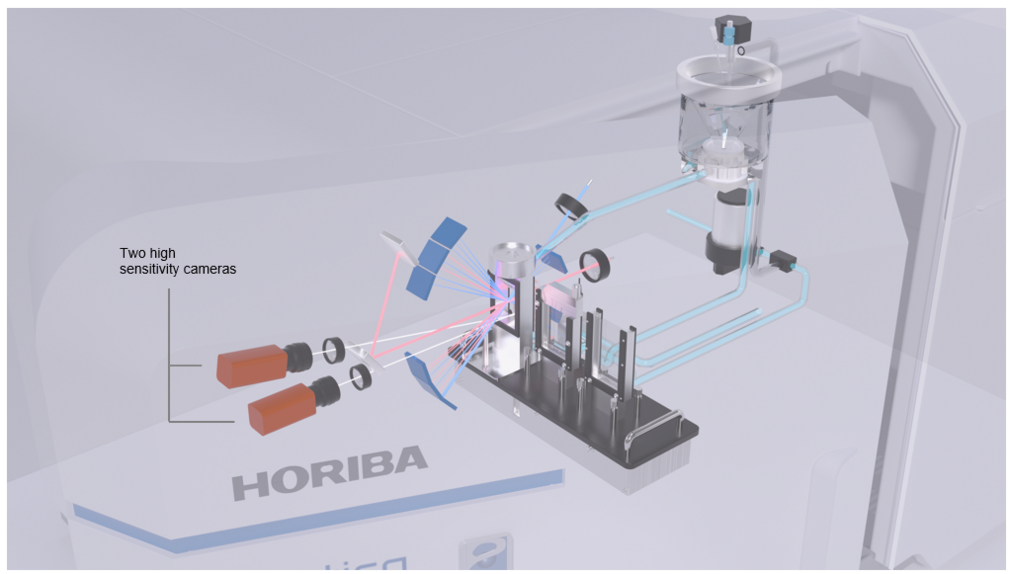
- Two-camera configuration enables particle imaging across a wide size range
- Supports particle size and shape analysis for multiple sample forms, including liquids, slurries, and powders
- Highly customizable, scalable platform designed for maximum expandability
Click the Link for the Product Video
Laser Diffraction and Dynamic Imaging Particle Size and Shape Analyzer – optimized as one analyzer
- By consolidating both techniques into a single system, Partica significantly reduces total measurement time, improves efficiency in R&D and quality control in a significantly smaller footprint.
- It supports particle size and shape analysis across a broad range of sample types and concentrations—from water-soluble materials such as pharmaceuticals and foods, to dry powders, and high-solids samples such as battery materials.

Particle size and shape analysis for a wide range of sample forms, including liquids, slurries, and powders
- For laser diffraction, Partica builds on industry-leading measurement accuracy (within ±0.6% of certified reference particle standards) and a wide measurement range (10 nm to 5 mm). Further refinements to the optical system also deliver increased sensitivity.*
- For dynamic imaging, high-resolution optics capture detailed particle shape information from approximately 1 µm up to the millimeter scale.
- For shape analysis, the system extracts more than 30 particle shape parameters, including equivalent diameter, minimum/maximum (Feret) diameter, circularity, and aspect ratio.
*Based on HORIBA’s internal research (as of December 2025)
【Application by Partica technology】Silica slurry quality analysis
Particle size and distribution analysis are enhanced by using multiple technologies, delivering a more powerful overview of the material testing. Here is an example of a combination of static light scattering and imaging technology that complements one technique. This silica slurry analysis, comparing both technologies, reveals very few large contaminants or agglomerated particles while providing detailed characterization data that can help identify and resolve potential issues during the manufacturing quality control process.
Partica has simultaneous dual‑mode analysis combines laser diffraction measurement with particle imaging, delivering complementary data in a single test.

Two-camera system captures particle images across a wide size range
- By incorporating two cameras with different resolutions, the system enables wide-range measurements—from approximately 1 µm to several millimeters.
- It acquires 300 frames per second at maximum, allowing tens of thousands of particles to be analyzed in a short time.
- It eliminates the need for time-consuming hardware changes such as switching microscope objectives or replacing apertures required in Coulter counter–based methods.
| Model | LA-1000 series | LA-970 series | |
|---|---|---|---|
| Measurement principle | DIA | Dynamic imaging analysis | – |
| LD | Mie scattering and fraunhofer diffraction | ||
| Total measurement range | 0.01 – 8000 μm | 0.01 – 5000 μm | |
| Measurement range (Wet) | DIA | 0.3 – 3000 μm* | – |
| LD | 0.01 – 3000 μm | ||
| Measurement range (Dry) | DIA | 1.1 – 8000 μm* | – |
| LD | 0.1 – 5000 μm | ||
| Light sources | LD (650 nm) : 5 mW, LED (405 nm) : Maximum 10 mW | ||
| Number of cameras | 2 (Dual camera system) | – | |
| Camera performance | Maximum 300 fps | – | |
| Digital resolution | Minimum 0.3 μm | – | |
| Measurement parameters | More than 30 image analysis parameters | – | |
| Dimensions and weight ** | 720 mm (W) x 565 mm (D) x 470 mm (H), Approximately 56 kg | ||
| Optional accessories | Powderjet Dry Powder Feeder, MiniFlow unit, Fraction cell, High Concentration cell, Paste cell | ||
* Depends on particle shapes
** Dimensions and weight exclude pipework and other protrusions, and optional accessories.