Quantum Sensor

LI-190R

The LI-190R measures Photosynthetically Active Radiation (PAR, in µmol of photons m-2 s-1). It provides accurate measurements—in the open, in greenhouses, under plant canopies, or in growth chambers—for most broad-spectrum light sources, including natural sunlight, artificial, or mixed sources.

Plants use light in the wavelength range from about 400 to 700 nm to drive photosynthesis. The efficiency with which plants use light varies somewhat across this range, but McCree1 showed that measuring PAR provided a consistent way to predict plant photosynthetic response regardless of the spectrum of the light source.2


Why choose the LI-190R Quantum Sensor?

  • Uniform sensitivity across the PAR waveband for accurate measurements outdoors, under vegetation, or in artificial lighting without changing the calibration
  • Newly designed optical filter tailors the spectral response to an unprecedented performance standard
  • Weather resistant and durable in high-temperature, high-humidity, long-term deployments
  • Cosine correction is accurate even when the light source is not directly overhead
  • Sensor heads are detachable and interchangeable for simplified installation, removal, and recalibration
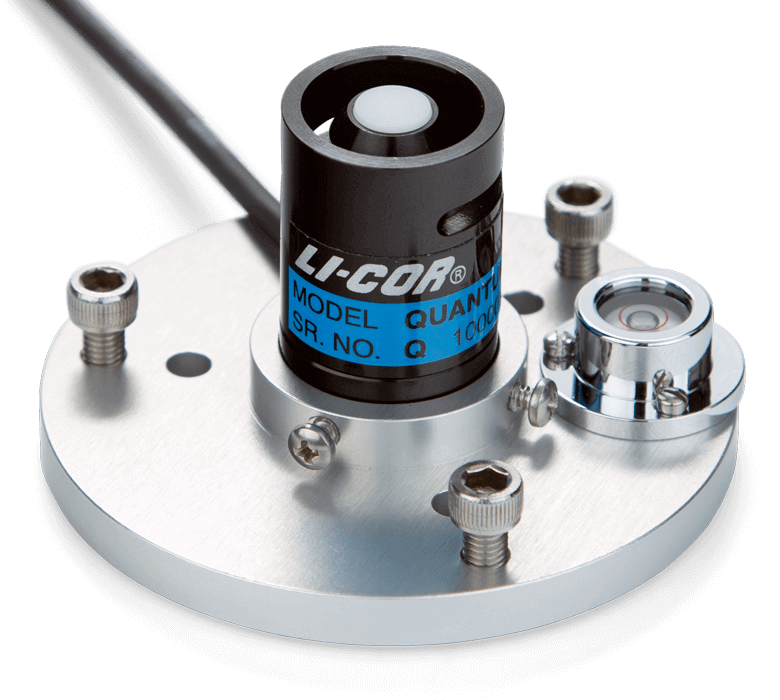
LI-190R on mount

How does it work?

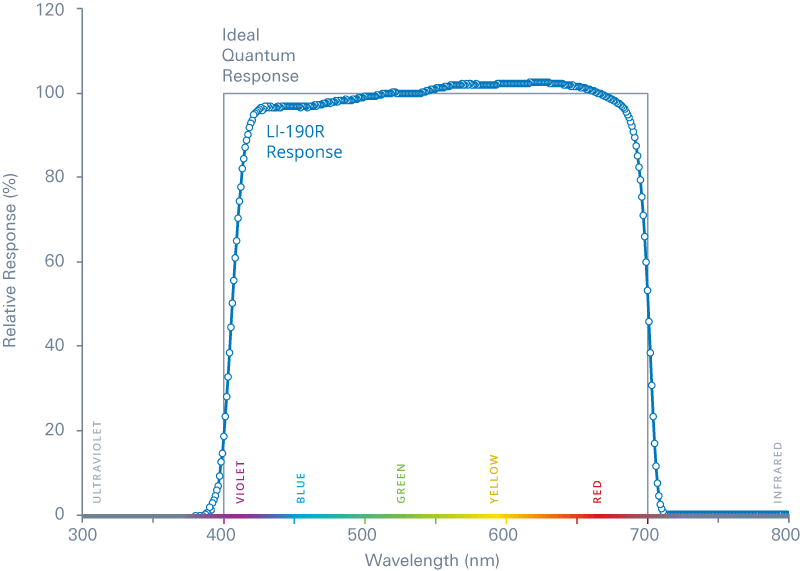
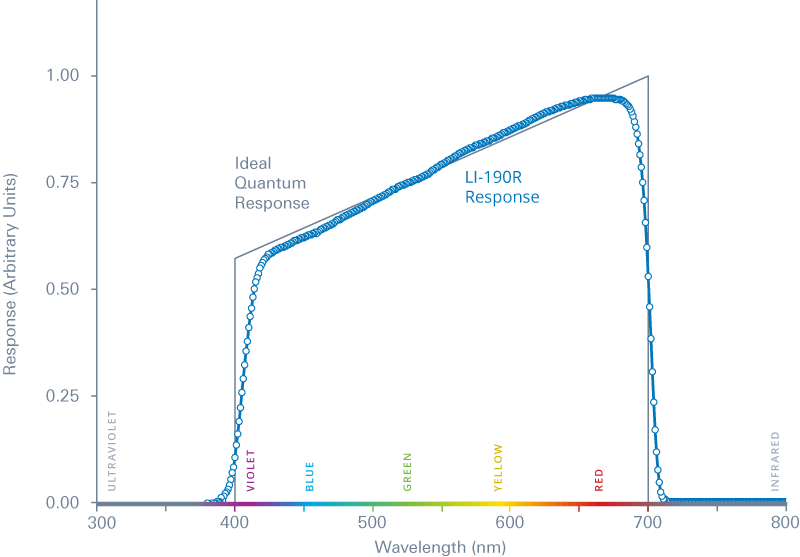
The LI‑190R uses a high-quality silicon photodiode and glass optical filter to create uniform sensitivity to light between 400 nm to 700 nm, which closely corresponds to light used by most plants. A newly designed optical filter tailors the spectral response to an unprecedented performance standard. Furthermore, the new filter is unaffected by environmental factors such as heat or humidity. The filter blocks light with wavelengths beyond 700 nm, which is critical for measurements under vegetation where the ratio of infrared to visible light may be high.
Quantum Response Photon Graph
The figure above shows the LI-190R response and the ideal quantum response in photon units
Quantum Response Energy Graph
The figure above shows the LI-190R response and the ideal quantum response in energy units

The sensor features excellent cosine response, which ensures accurate measurements under diffuse light and when sunlight originates from a low solar angle. This, in combination with high resolution at low light levels, makes the LI-190R useful for determining the light compensation point in plants.
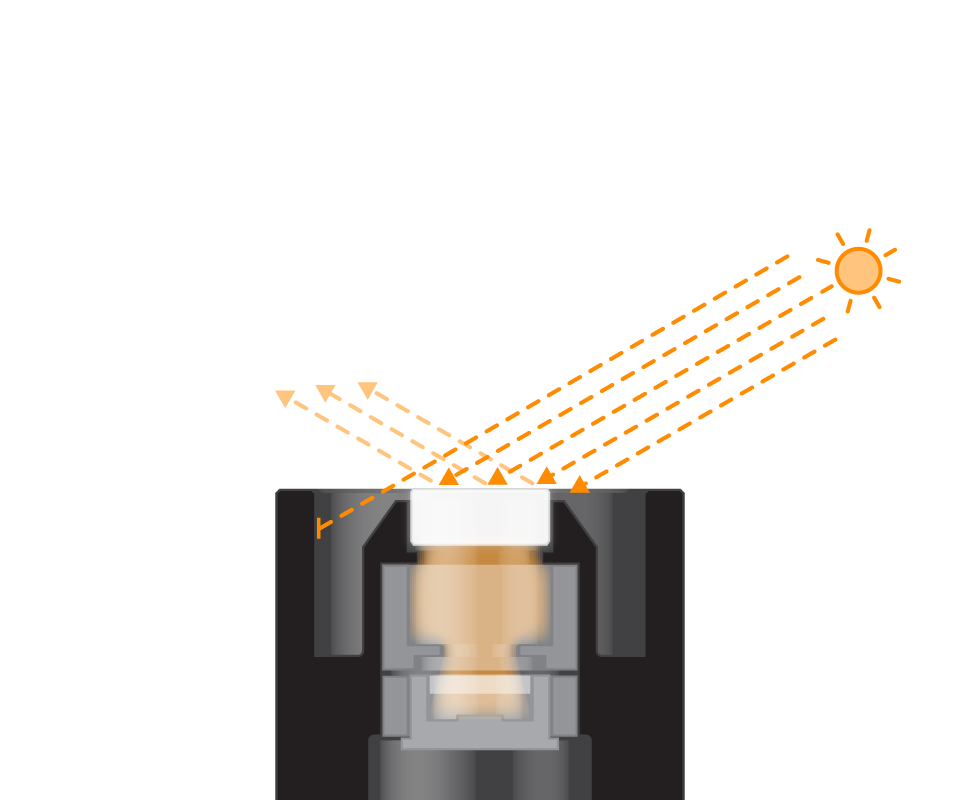
Cosine Response at an angle of incidence of 80 degrees

 Learn more about the science and engineering behind the new design

LI-190R Specifications

  • Absolute Calibration: ± 5% traceable to the U.S. National Institute of Standards and Technology (NIST)
  • Sensitivity: Typically 5 μA to 10 μA per 1,000 μmol s-1 m-2
  • Linearity: Maximum deviation of 1% up to 10,000 μmol s-1 m-2
  • Response Time: Less than 1μs (2 m cable terminated into a 604 Ohm load)
  • Temperature Dependence: ± 0.15% per °C maximum
  • Cosine Correction: Cosine corrected up to 82° angle of incidence
  • Azimuth: < ± 1% error over 360° at a 45° elevation
  • Tilt: No error induced from orientation
  • Operating Temperature Range: −40 °C to 65 °C
  • Relative Humidity Range: 0% to 100% RH, Non-Condensing
  • Detector: High stability silicon photovoltaic detector (blue enhanced)
  • Sensor Housing: Weatherproof anodized aluminum body with acrylic diffuser and stainless steel hardware; O-ring seal on the sensor base
  • Size: 2.36 cm diameter × 3.63 cm (0.93” × 1.43”)
  • Weight: 24 g head; 60 g base/cable (2 m) with screws
  • Cable Length: 2 m, 5 m, 15 m, 50 m (6.5’, 16.4’, 49.2’, 164’)

LI-COR LI-190R Quantum Sensors – Sigmatech Inc. Philippines
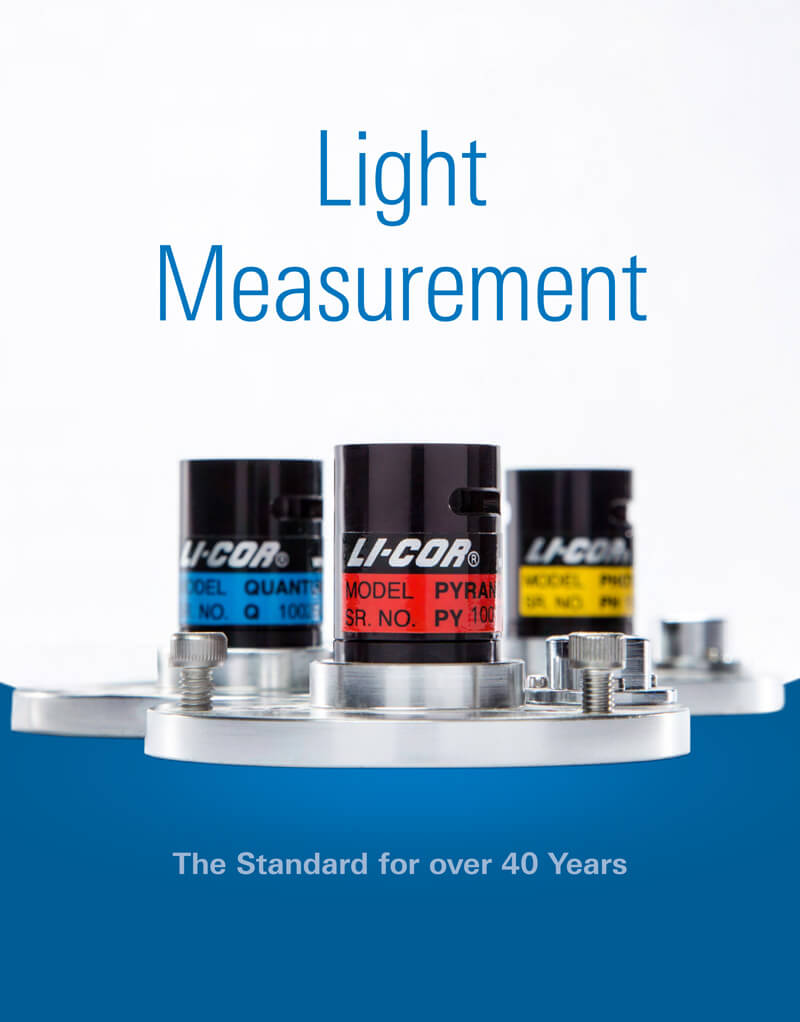
Brochures

Light Measurement

Light Measurement Solutions for Greenhouse Management

LI-1500 Light Sensor Logger

Principles of Radiation Measurement

Field guide to instruments for the earth sciences

Features

Why choose the LI-190R?

  • Uniform sensitivity across the PAR waveband for accurate measurements outdoors, under vegetation, or in artificial lighting without changing the calibration
  • Newly designed optical filter tailors the spectral response to an unprecedented performance standard
  • Weather resistant and durable in high-temperature, high-humidity, long-term deployments
  • Cosine correction is accurate even when the light source is not directly overhead
  • Sensor heads are detachable and interchangeable for simplified installation, removal, and recalibration
LI-190R on mount

How does it work?

The LI‑190R uses a high-quality silicon photodiode and glass optical filter to create uniform sensitivity to light between 400 nm to 700 nm, which closely corresponds to light used by most plants. A newly designed optical filter tailors the spectral response to an unprecedented performance standard. Furthermore, the new filter is unaffected by environmental factors such as heat or humidity. The filter blocks light with wavelengths beyond 700 nm, which is critical for measurements under vegetation where the ratio of infrared to visible light may be high.

Normalized response in photon units

Quantum Response Photon Graph

The figure above shows the LI-190R response and the ideal quantum response in photon units
Response in energy units

Quantum Response Energy Graph

The figure above shows the LI-190R response and the ideal quantum response in energy units

The sensor features excellent cosine response, which ensures accurate measurements under diffuse light and when sunlight originates from a low solar angle. This, in combination with high resolution at low light levels, makes the LI-190R useful for determining the light compensation point in plants.

Cosine Response at an angle of incidence of 80 degrees

 Learn more about the science and engineering behind the new design

LI-190R Specifications

  • Absolute Calibration: ± 5% traceable to the U.S. National Institute of Standards and Technology (NIST)
  • Sensitivity: Typically 5 μA to 10 μA per 1,000 μmol s-1 m-2
  • Linearity: Maximum deviation of 1% up to 10,000 μmol s-1 m-2
  • Response Time: Less than 1μs (2 m cable terminated into a 604 Ohm load)
  • Temperature Dependence: ± 0.15% per °C maximum
  • Cosine Correction: Cosine corrected up to 82° angle of incidence
  • Azimuth: < ± 1% error over 360° at a 45° elevation
  • Tilt: No error induced from orientation
  • Operating Temperature Range: −40 °C to 65 °C
  • Relative Humidity Range: 0% to 100% RH, Non-Condensing
  • Detector: High stability silicon photovoltaic detector (blue enhanced)
  • Sensor Housing: Weatherproof anodized aluminum body with acrylic diffuser and stainless steel hardware; O-ring seal on the sensor base
  • Size: 2.36 cm diameter × 3.63 cm (0.93” × 1.43”)
  • Weight: 24 g head; 60 g base/cable (2 m) with screws
  • Cable Length: 2 m, 5 m, 15 m, 50 m (6.5’, 16.4’, 49.2’, 164’)

Brochures

Light Measurement

Light Measurement Solutions for Greenhouse Management

LI-1500 Light Sensor Logger

Principles of Radiation Measurement

Field guide to instruments for the earth sciences

Related Products

The LI-COR LI-6800 Portable Photosynthesis System is a cutting-edge tool designed for precise measurements of photosynthetic gas exchange and chlorophyll a fluorescence.
Rugged and compact, the redesigned HOBO USB Micro Station is a weatherproof data logger for multi-channel monitoring of microclimates.
Enabled with cellular communication, this award-winning remote water level monitoring station completes calculations onsite and sends notifications of critical conditions via cellular plans to LI-COR
The LI-190R Quantum Sensor measures photosynthetically active radiation (PAR). The LI-190R is designed for use in horticulture, ecology, greenhouses, and more.
The LI-191R Line Quantum Sensor measures PAR integrated over its 1-meter length. It is used to measure sunlight under a plant canopy, where the light field is non-uniform.
A single-channel thermocouple data logger to measure and record temperature in indoor environments.
The LI-180 Spectrometer lets you capture the spectral composition of your light sources with a single click.
A miniature, value-priced, waterproof data logger for temperature monitoring applications.
Choose the LI-250Q package for spot measurements of photosynthetically active radiation (PAR) intensity and quantity with unrivaled accuracy.
Monitors room occupancy and indoor light changes to identify occupancy patterns and determine energy usage and potential savings.

How can we help?

You may contact our specialists by accomplishing form below.

failure analysis, material characterization, and metrology equipment

Subscribe to newsletter

Sign up for our newsletter to get updates on promos, seminars, events, products, application notes and more.

Inquire for this Product

LI-190R
Quantum Sensor
LI-190R
Quantum Sensor