
High Milling Rate
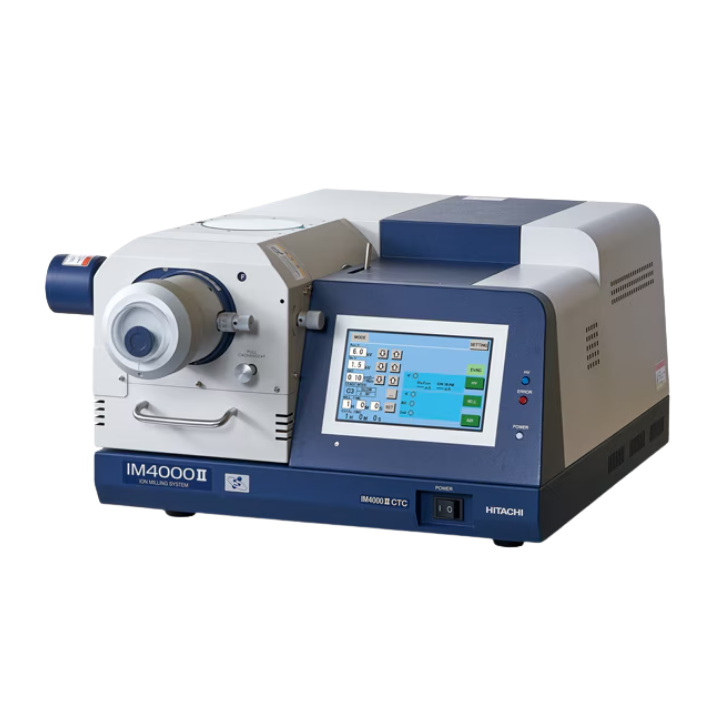
The cross section milling rate of the IM4000II is 500 µm/h or greater. It is effective for hard materials that conventionally require extended processing.
*The maximum milling depth in one hour for Si protruding 100 μm from the maskedge.
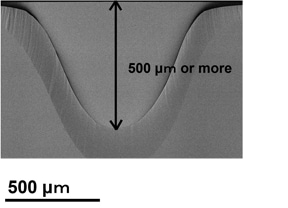
Specimen: Si wafer (2 mm thick)
Accelerating voltage: 6.0 kV (IM4000II)
Swing angle: ±30°
Milling time: 1 hour
When the swing angle during cross section milling changes, the corresponding processing width and depth change. The figure below shows the SEM images of a Si wafer after cross section milling. Processing conditions are the same as shown above except the swing angle has been reduced from ±30˚ to ±15˚. It is demonstrated that the processing depth is deeper than the above results and therefore very effective for rapid cross section preparation of specimens with a target structure far from the top surface.
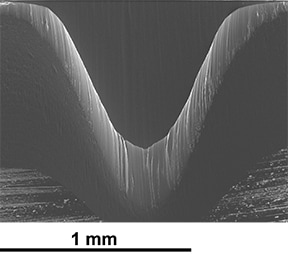
Specimen: Si wafer (2 mm thick)
Accelerating voltage: 6.0 kV (IM4000II), 8.0 kV (ArBlade 5000)
Swing angle: ±15°
Milling time: 1 hour
Hybrid Milling
Cross section Milling
A pristine surface can be achieved by sputtering (milling) protruding parts of the specimen that extend beyond the maskedge. By irradiating the ion-beam parallel to the processed surface of the specimen, flat and smooth milling is possible even with complex materials of different compositions.
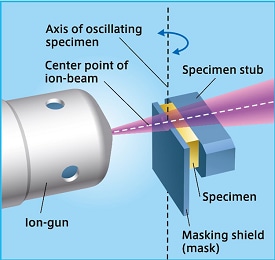
Main Uses
- Prepare a cross section specimen in a localized region of interest (ROI)
- Prepare a cross section specimen that is difficult to polish by other methods (composite materials, multi-layer interface, papers/films, etc.)
Flat-milling
In flat-milling, a wider area can be processed than in cross section milling via eccentricity of the ion-beam and rotating specimen center points. It is also possible to emphasize or reduce irregularities by changing the irradiation angle of the ion-beam in order to reveal crystal orientation and/or subtle compositional differences.
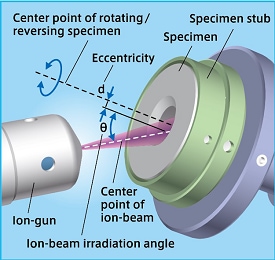
Main Uses
- Remove mechanical artifacts from the polishing process (maximum diameter of 50 mm x thickness of 25 mm)
- Remove the surface or upper layers of multilayer film
- Discriminate layers of the cross section for multilayer film (emphasizing irregularities)
- Preprocess large areas for EBSD (reducing irregularities)
Options
Cooling Temperature Control
Sensitive specimens can be cooled with liquid nitrogen during processing. The cooling temperature control uses indirect cooling and maintains a temperature during processing in order to prevent phase transitions.
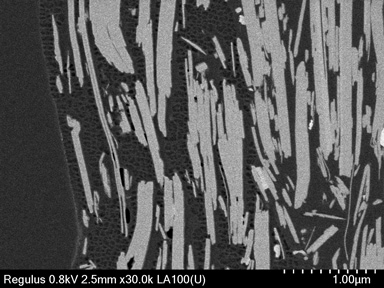
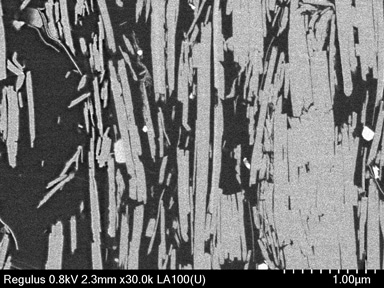
In the example below, specimen cooling suppresses thermal deformation in the heat-sensitive styrene-based latex, resulting in a smooth processed surface.
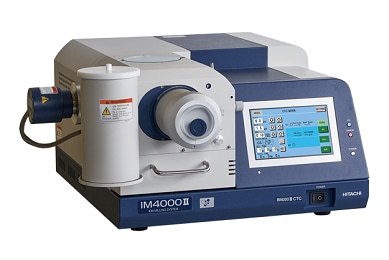
*Option to deliver with the main unit
Specimen: Functional material to reduce plastic usage (Made of paper)
Air Protection Holder Unit
The Air Protection Holder can be used to keep air-sensitive specimens (such as battery material) isolated from the environment. A specimen fabricated using the IM4000II can be loaded into a SEM and/or Atomic Force Microscope (AFM) without exposure to the outside environment. This function can be used in combination with the cooling temperature control (except a flat-milling holder).
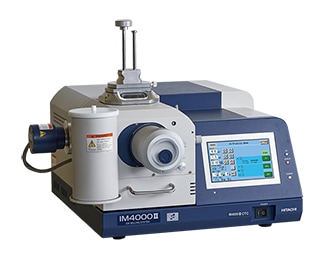
*Compatible only with Hitachi High-Tech FE-SEM with air protection holder unit.
*Compatible only with Hitachi High-Tech AFM with vacuum.
Stereo Microscope Unit for Process Observation
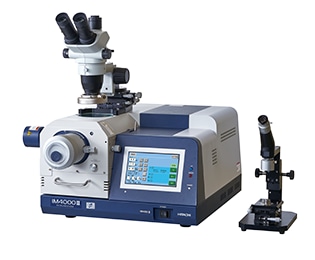
A stereo microscope can be outfitted to observe the specimen during the milling process. Both binocular and trinocular-type systems are available. The trinocular version (as shown below) allows for view streaming to an external monitor when equipped with a CCD camera.
Specification
| Gas used | Ar (argon) gas |
|---|---|
| Ar gas flow control system | Mass flow controller |
| Accelerating voltage | 0.0 to 6.0 kV |
| Size | 616(W)×736(D)×312(H) mm |
| Mass | Main unit : 53 kg+Rotary pump : 30 kg |
| Maximum milling rate(Material : Si) | 500 μm/h*1 or more |
|---|---|
| Maximum specimen size | 20(W)×12(D)×7(H) mm |
| Specimen moving range | X±7 mm, Y 0 to +3 mm |
| Ion-beam intermittent irradiation | ON/OFF setting range 1sec to 59 min 59 sec |
| Swing angle | ±15°, ±30°, ±40° |
| Wide-area cross section milling | – |
*1The maximum milling depth in one hour for Si protruding 100 μm from the maskedge.
| Maximum milling area | φ32 mm |
|---|---|
| Maximum specimen size | Φ50×25 (H) mm |
| Specimen moving range | ×0 to +5 mm |
| Ion-beam intermittent irradiation | ON/OFF setting range 1sec to 59 min 59 sec |
| Rotation speed | 1 rpm, 25 rpm |
| Swing angle | ±60°, ± 90° |
| Ion-beam irradiation angle | 0 to 90° |
Optional Specification
| Cooling temperature control*2 | Indirect cooling by LN2, Range of set temperature : 0 to -100 ℃ |
|---|---|
| Higher beam tolerance mask | 2× beam tolerance as compared to the standard mask (Cobalt-free) |
| Stereo microscope unit for monitoring the process | 15× to 100×, Binocular type, Trinocular type (correspond to CCD camera) |
*Option to deliver with the main unit. Some functions may be restricted during the use of cooling temperature control.